The intellectual and philosophical foundation that shapes every engagement.
Why Human Capital Is the Primary Multiplier
Every organisation depends on multiple forms of capital, but people activate them all. Strategy, technology, structure, and financial investment only create value through leadership, behaviour, decision-making and execution. When human capital is weak, everything underperforms. When it is stewarded intentionally, organisations become more adaptive, resilient, and capable of sustainable growth.
Why Mechanical Models Fail
Many organisations still operate through mechanical thinking: control, rigidity, and linear systems. That approach breaks down in complexity. Modern organisations are living systems shaped by uncertainty, rapid change, and human dynamics. Sustainable performance emerges through alignment between people, culture, structure, and leadership, not through process alone. Living systems thinking creates adaptability, resilience, and long-term coherence.
Why Leadership Is the Missing Link
The greatest organisational challenge is rarely a lack of knowledge. It is a lack of leadership ownership. Traditional consulting often creates dependency instead of capability. Sustainable change happens when leaders take responsibility for purpose, culture, execution, and people stewardship themselves. The decisive factor is therefore not better advice, but leaders equipped to lead through complexity with clarity, maturity, and accountability.
Empirical Foundation
How Do You Accurately Measure the Value of Your Company?
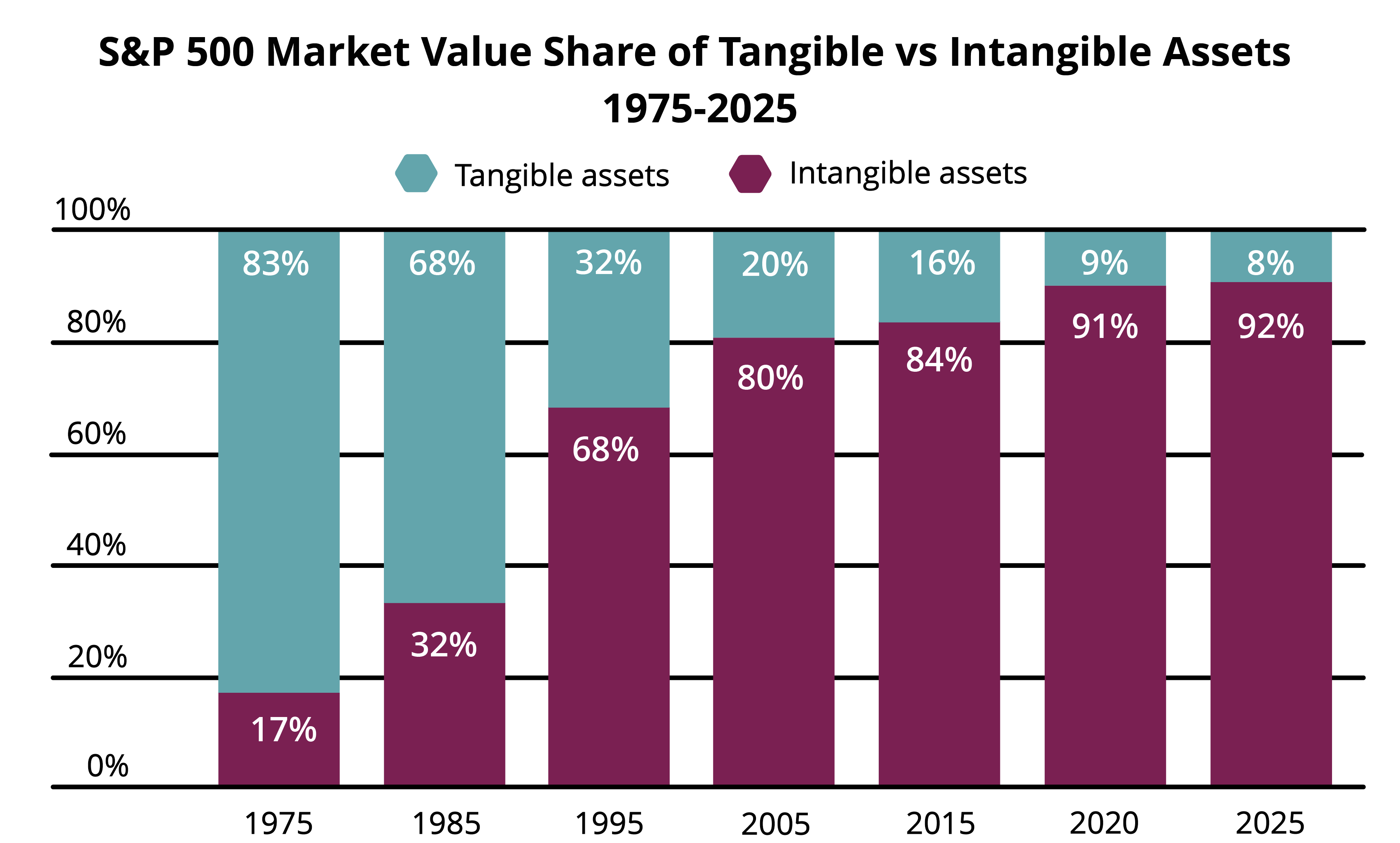
There is no simplistic answer, but it begins with understanding the organisation’s total capital value. Traditionally, this has focused on tangible assets, assessed through due diligence and reflected in financial statements. Research on the S&P500 over four decades reveals a fundamental shift. In 1975, the ratio of tangible to intangible assets was approximately 5:1. By 2020, that ratio had reversed to nearly 9:1 in favour of intangible assets, with human capital being the single largest contributor.
This shift has led to a core conviction at CCI Professional: humancapital is not merely a pool of wealth; it is the foundation on which all othercapital rests. The critical question therefore becomes:
What is your organisation’s human capital investment strategy and is it aligned with your growth strategy?
Our Empirical Consulting Approach
Co-creation through structured dialogue, validated research and applied organisational design.
CCI Professional approaches organisational and human capital through empirically grounded consulting. We do not impose solutions or deliver generic advisory recommendations. Instead, we co-create with leaders through structured dialogue, statistically validated research and applied organisational design.
Our Empirical Research Based Consulting Model enables both qualitative and quantitative evaluation, ensuring that decisions are grounded in measurable reality rather than assumption. Research informs insight. Insight guides co-creation. Co-creation shapes sustainable implementation.
Just as a plant with strong potential cannot flourish in an unhealthy habitat, organisations cannot expect performance if their environment is misaligned with their mission. Through the Mission Alignment Process (MAP), we evaluate and redesign purpose, strategy, structure, culture and performance systems to create conditions in which people can excel and contribute meaningfully.
Human Capital Crafting
People-Centric
Human Capital Crafting strengthens individual and collective capability through the Human Capital Mastery Model (HCMM). This four-quadrant framework integrates leadership and followership dynamics with developmental support levels, providing a systematic pathway for growth.
Optimising only the environment creates confusion. Developing only people creates frustration. Sustainable multiplication requires both.